It’s Thursday
Posted by tonypcollins in 01. It's Thursday on July 24, 2024
and another week has gone.
That’s what I recall my beloved Gran lamenting on a regular basis as she observed the ever quickening passage of time, like grains of the golden sand that creep through my fingers to the deep. But I was young then and it didn’t really resonate with me; and gran was probably younger then than I am now. But the memory came back when I woke up on a Thursday morning that was the start of never going back to the office again. I had retired. The farewell party, such as it was, was over. They said, ‘don’t be a stranger’; they meant ‘don’t be a pest’. The treadmill has been switched to ‘warm-down’ mode; now there is more time to do things other than the daily habit of going to work; so the question arose of how to fill in my days now? People have started knocking on my door to bring me the “good news” or try to sign me up for one cause or another.
I think I need to get out of the house more. But my daughter gave me a blog site for Christmas. That could be fun, ranting into the ether.
New Year, time to think
Posted by tonypcollins in 01. Where did the time go? on January 14, 2026
It’s January again, which means we have quietly stepped back onto the familiar twelve-month wheel — the long months and short ones, the drifting dates, the lopsided February — without ever really stopping to ask why time is divided this way at all. We reset our diaries and calendars as if this structure were natural and inevitable, when in fact it is neither. We inherit it without question, even though other, simpler ways of measuring the year have always existed. We get discombobulated with Christmas day, New Years day and other anniversaries all moving to different days of the week each year. Life would be so much simpler if they always fell on the same day of the week. So what if there is a way of dividing the year that is so simple, so symmetrical, and so human‑friendly that it almost feels obvious — and that the only reason we do not use it is because of an eleven‑minute error made by Julius Caesar two thousand years ago?
The calendar we all live by — the Gregorian calendar — exists almost entirely to fix a mistake in the Roman one. The old Julian calendar assumed the year was about eleven minutes longer than it really is. Over centuries, that tiny error caused the spring equinox to drift earlier and earlier. But the Church had used a fixed date, 21 March as the Spring equinox and by the 1500s it was ten days out. The calendar we live inside today — with its uneven months and centuries-old quirks — was laid down in 1582 by Pope Gregory XIII as a reform of Julius Caesar’s older system, not to make daily life simpler but to keep the date of Easter aligned with the seasons. Because the most important festival in Christianity, Easter, is not fixed to a date at all. It is defined as the first Sunday after the first full moon after the spring equinox. When the equinox drifted, Easter drifted with it. That meant that the celebration was moving further back from Spring with its rebirth/ resurrection symbolism and backwards with Lent preparation then in the depths of Winter. Theology had slipped out of step with the weather and Pope Gregory decided that had to change.
So the Church rewrote the calendar. Ten days were removed. Leap‑year rules were changed. The months were left as they were. All of it was done not for the convenience of daily life, but to keep the resurrection aligned with a solar‑lunar choreography inherited from much older traditions. In a quiet way, that means Christianity’s most sacred moment is still tied to ancient sky‑watching. The story of the Three Magi — Persian astronomers who followed a star to the birth of Jesus — reflects the world Christianity emerged from: one in which celestial rhythms mattered deeply.
And that is the quiet irony: the modern world keeps time the way it does because Christianity had to keep Easter aligned with the Moon.
Thirteen months of twenty‑eight days give us 364 days: exactly fifty‑two weeks. Every month has four neat weeks. Every date always falls on the same weekday. No drifting holidays. No short February. No long, lopsided months. It is the closest thing to a perfectly designed calendar that human arithmetic allows. The 365th day would simply become a ‘year-day’. Everything would simply stop for a one day reset which would truly be a New Years Eve. This is not a new idea; in1849 Auguste Comte proposed it. In 1902 Moses Cotsworth formalised it as the International Fixed Calendar. From 1928 to 1989 Kodak ran its entire global business on a 13-month calendar. It worked so well they refused to change until computer systems forced them.
Modern psychology helps explain why this matters. Human beings thrive on regular rhythms. Predictable weeks and routines support sleep, mood, and a sense of control. A calendar in which time repeats cleanly would not just be easier to plan — it would be easier to live inside.
Calendars are not just cultural habits. They are embedded in banking systems, tax law, software, contracts, pensions, and international agreements. To change the calendar today would mean rewriting the legal and digital spine of civilisation. That does not happen because something is elegant or humane. It happens only when something overwhelmingly powerful insists.
There is a strange physical symbol of all this in the most complicated watch ever made: the Vacheron Constantin Reference 57260, sometimes called the Tivoli.


Built by three watchmakers over eight years for a single client, It is undeniably a pretty cool watch. There’s an astronomical calendar, which includes a display of the phases and age of the moon, a hand that tracks the movement through the Zodiac along with the equinoxes and solstices and a rotating sky chart. There are three full calendar systems in this watch. The first is a Gregorian perpetual calendar that includes displays for the date with a retrograde hand, day of the week, month and year in the leap year cycle. There are also indicators for the number of the day of the week and number of the week in the year in accordance with the ISO 8601 standard calendar. There is also a Hebrew perpetual calendar which shows the Hebrew name of the day, Hebrew name of the month, Hebrew date, Hebrew secular calendar, Hebrew year, whether the year has 12 or 13 months, where in the 19-year lunar cycle this year is, and the date of Jewish holy day Yom Kippur, which moves around the calendar. It has a double retrograde split-seconds chronograph and…. it tells the time in both sidereal and solar hours and minutes. Sidereal time tracks the earth in relation to the stars instead of in relation to the sun and differs from solar time by plus or minus a few minutes. Sometimes a few minutes make all the difference. You can also see what time the sun will rise and what time it will set in the watch owner’s home city as well as how long the day and night will each be on that day. The hours and minutes are shown with regulator-style hands, meaning the hours and minutes are on separate axes. The small gold hands show a second earthly time zone.
It is breathtaking, but it is also quietly absurd. Time itself is simple: the Earth turns, the Moon circles, the seasons pass. The watch is complex because human history is. It exists to reconcile Roman months, Christian Easter, Lunar cycles, Hebrew Calendar and centuries of patched-together rules. In a way, it is the mechanical opposite of a thirteen-month calendar: a monument to how elaborate our systems become when we refuse to let time be simple.
We often think calendars are neutral tools, but they shape how rushed or settled we feel, how we plan, how we remember, and how we rest. A few things become clear once you start looking at calendars closely:
- A thirteen-month year creates identical months and predictable weeks.
- Dates and holidays would always fall on the same weekday each year.
- Weeks and months would finally align cleanly, without spilling across one another. the 1st of the month is always the same day of the week, as is the 28th of the month.
- Billing, pay cycles, school terms, and planning would become simpler and fairer.
- The extra “Year Day” would introduce a natural pause rather than another deadline.
- Our current system persists not because it is better, but because it is deeply embedded in law, finance, culture, and software.
As this New Year gets underway, is it time to question why we still live inside a calendar designed to solve a sixteenth-century theological problem — when a gentler, more human rhythm has always been waiting just beyond it.
And perhaps in an age where software and artificial intelligence can quietly reconcile complexity for us, it is at least worth asking whether the way we organise time still needs to be as tangled as the history that created it.
And it makes you wonder: if we gave time a little more symmetry, with a ‘one day pause’ in between would we live our life just a little differently?
Easter uprising
Posted by tonypcollins in 18. Easter uprising on March 17, 2025

New Testament: Acts 1:9-11 “he was taken up into a cloud while they were watching, and they could no longer see him. As they strained to see him rising into heaven, two white-robed men suddenly stood among them. “Men of Galilee,” they said, “why are you standing here staring into the heavens? Jesus has been taken from you into the heavens, but someday he will return in the same way you saw him go!”
The Modern Christian religion is based on the New Testament of the Bible which was endorsed around 400AD when the Christian Church was under the control of the Roman Emperor Constantine and his appointed Bishop of Rome. The endorsed historical narrative declares that Jesus of Nazareth was crucified because the Roman Governor believed he had revolutionary messianic aspirations to be king of the Jews. Apart from the Essene priestly sect, there were numerous Jewish revolutionaries declaring messianic ambitions in that land in those times of Roman occupation. According to historians of the1st century, in 4bc a shepherd named Athronges gathered up a number of followers and proclaimed himself as king of the Jews, they were all slaughtered by Roman soldiers. Pontius Pilate crucified another called only ‘The Samaritan’ to whom the title Messiah had been used. Other messianic aspirants mentioned in history are Hezekiah the bandit, Simon of Peraea, Judas the Galilean, Menahem, Simon son of Giora, and Simon son of Kochba, all of whom were executed. In first century Palestine, even to publicly state ‘this is the messiah’, was a crime punishable by crucifixion, such was the paranoia of the Romans with the potential for a Jewish uprising against Roman occupation. The difference between Jesus and those would-be messsiahs executed for the same crime against Rome, was Jesus’ recovery from a crucified death and his subsequent ascension into a hovering cloud in the sky from the Mount of Olives. This is actually the true basis of the religion for it was based on witnessing this event that his followers had the conviction and courage to face persecution, torture and cruel death to challenge Rome by promoting Jesus as having risen from the death that had been inflicted upon him by the Romans. In effect that Jesus was therefore more powerful than the Emperor and might of Rome.
In considering the Easter narrative that Jesus died on the cross and on the third day was resurrected as God, pause to recall the Roman Catholic Church’s choice for Jesus’ birth day celebration as the 25 December which is the third day after the winter solstice when the sun had descended onto the Crux (cross) constellation and was below the horizon until the third day when it rose again. So his birth narrative has an uncanny synchronicity with his death. For a Church which believed that Jesus’ resurrection and physical ascension into the heavens demonstrated the triumph of God over the pagan forces of nature, it is peculiar then that the date of Easter changes annually, based on the timing of the first weekend following the full moon that followed the Spring Equinox. The timing also accommodates the Jewish Passover festival which again is a movable feast based around the Spring Equinox. This is an undeniably pagan calendar and coincides with a long-established Spring Equinox pagan festival. This came about because in 595 AD, Pope Gregory sent a mission of 40 monks led by a Benedictine monk called Augustine, who became the first Archbishop of Canterbury, with instructions to convert Pagans to Christianity by superimposing Christian events over established Pagan festivals. The Spring equinox celebration in paganism (witchcraft) today is called the feast of the Germanic goddess of fertility and new birth “Ostara” or “Oeste”, which is clearly the root name for our Easter. This is one of the eight neopagan holidays that make up the pagan wheel of the year. And if we dig a little deeper in history to paganism in Rome at the time of Emperor Constantine, we also find the older Spring Equinox festival where they believed in a goddess Cybele, the great mother of Gods, who had a consort named Attis. Attis had been a shepherd who was believed born of a virgin birth from his mother, Nana. Attis died from self mutilation beneath a pine tree having broken a promise to Cybelle but, according to myth, by the power of Zeus his body did not decompose and he was resuscitated.
This Roman Pagan Spring festival was celebrated over a three day period 10-7 days before the April new moon. The 3rd day of the festival, called Hilaria, was a day of rejoicing at Attis’ resurrection. It is recorded that during this festival a pine tree was cut in the woods and brought to the sanctuary of Cybele. The duty of carrying the tree was entrusted to a guild of Tree bearers. The trunk was swathed like a corpse with woolen bands and decked with wreaths of violets (violets were reputed to have sprung from the blood of Attis). The parallel to our Christian mourning of Jesus bearing the cross through the streets of Jerusalem to Golgotha is uncanny. On the third day of the festival the high priest (Archigallus) drew blood from his arm and offered it as a sacrifice. The lower rank clergy also danced their way into a frenzy of self-mutilation to splatter their blood on the tree. The splattering of blood was supposed to be an aid to resurrection. Again, the sacrament of the blood of Christ offered up at the last supper is an uncanny parallel. The subsequent rebirth of nature as spring progressed is then seen as proof of the restoration of life. The worship of Cybele and Attis was brought to Rome from Phygria (Asia Minor) in 204 bc. Attis was made a solar deity in the 2nd century ad so was an established Roman god at the time of Nicaea. The black stone (meteorite) in which the spirit of the goddess was embodied was entrusted to the Romans who installed it in the temple of Victory on the Palatine Hill. The subsequent harvest was exceptionally good and her position in their belief system was established.
And so it came about that the crucifixion, resurrection and ascension into a hovering cloud in the heavens of Jesus the Nazarene co-existed with, or overwrote, the existing Pagan narratives as the official Roman Cybele-Attis cult celebration of the rebirth of Spring. There are three published records in the New Testament of Jesus’ being with his trusted followers after his crucifixion but each one was a very secretive contact, Jesus and his angels in white robes were not going to give the High Priests and Romans a second opportunity at crucifixion. And from the last meeting at Bethany, he literally disappeared into the sky and according to the Bible was never seen in person again.
All the way through my Roman Catholic upbringing, the core of our faith was based on the dogma ‘that Jesus, son of God, died on the cross for man’s sins; so that man could now become righteous in God’s eyes’ 1 Peter 2:24: “He himself bore our sins in his body on the cross, so that we might die to sins and live for righteousness.” This dogma referenced back to the last supper on Good Thursday, the commemoration of the start of the four day drama that would result in the crucifixion and resurrection of Jesus the Messiah was the evening of his last meal with his closest disciples. During the meal he metaphorically handed them his body, in the form of bread, and poured his blood, in the form of wine, instructing his disciples to continue to perform this ceremony in memory of him; and Christians continue this ritual to this day. In the gospels, there is no deeper explanation of the meaning; it simply manifests the message for which Jesus wished to be remembered. It bears, however, an uncanny reference to an event that was recently discovered written on clay tablets dating back to 1650 BCE, buried in what was the first Assyrian palace built by King Sargon 11 near Ninevah in 709BC. Tens of thousands of clay tablets which were removed for translation and preservation. The texts, written around 1650 bee, 250 years before Moses, were slowly decoded and eventually published in 1965 by W. G. Lambert and A. R. Millard. The texts actually contain an account of the the minor gods rebelling against the heavy workload they were forced to do with the solution being the sacrifice of a God in order to create intelligent man to become their slaves.
“Let her create, then, a human, a man, Let him bear the yoke! Let him bear the yoke! Let man assume the drudgery of the gods. They slaughtered Aw-ilu, who had the inspiration, in their assembly. Nintu mixed clay with his flesh and blood. That same god and man were thoroughly mixed in the clay. For the rest of the time they would hear the drum. From the flesh of the god the spirit remained. It would make the living know its sign. Lest he be allowed to be forgotten, the spirit remained.”
If I had to think about the Roman Catholic account by comparison, I would have to puzzle over why Yeshua would need to suffer torture and die a cruel death as a means of atoning for the evils of man. There seems no co-relation. How would being rejected, tortured, and killed by humans make humans more acceptable to God as a righteous species? But once Rome became the holy seat of the Church rather than Jerusalem, the blame for Jesus’ death was attributed to a divine decision to sacrifice his son for the forgiveness of the sins of all men, rather than being a military execution of a dissident by the Roman Governor. Jesus’ mission was clarified as not that of a descendant of King David, ordained to free the Jews from the yoke of Rome, but rather as one of saving the souls of all mankind. It was ‘agreed’ that Yehshua died, not for the crime of sedition against the Roman occupiers of Israel and their Rabbi puppets, but rather in atonement for the sins of all mankind. It became almost as if the Romans had been given no choice but to crucify Yehshua because this death was ordained by God, who had predetermined to sacrifice his son in atonement for the sins of all humans. It wouldn’t be the first time that history was rewritten.
How much do we really now know, then, about the early Christians? And what did they really believe? How closely did the early Christians’ records of the life of Yahshua align with the narrative that Constantine of Rome endorsed, for political reasons, 300 years after Yehshua’s death. It was Peter, and later Paul, who first started preaching to the Romans, sometime after the crucifixion. But this caused divisiveness with the Christians who remained in Jerusalem and stayed faithful to the original mission as stated by Mathew’s (10:5) account of Jesus’ instruction. “Do not turn your steps into pagan territory and do not enter any Samaritans town; go rather to the lost sheep of Israel.” And later in Mathew 15:12 when a Canaanite woman asked for help, Jesus replied “I was sent only to the lost sheep of the House of Israel……it is not fair to take the children’s food and throw it to the house dogs.” And Jesus most certainly was not setting out to replace Judaism when he said in Mathew 5-17:“Don’t misunderstand why I have come. I did not come to abolish the law of Moses or the writings of the prophets. No, I came to accomplish their purpose.” When apostles spoke to Jesus after his resurrection, Acts1:6-8, and asked him, “Lord, has the time come for you to free Israel and restore our kingdom?” He replied, “The Father alone has the authority to set those dates and times, and they are not for you to know.” Very clear Judaic messages with a direct reference to the freeing of the kingdom of Israel from the Romans. But the moment the new Christian dogma was signed off in Nicaea, all links with Israel and Judaism were severed. And when the Roman Empire collapsed in the fifth century, it was the Church of Rome that continued the Roman mission, both religiously and militarily, to control western Europe and then onwards to the new world.
Devout Christians today take comfort in the promise of the two men in white who spoke to the apostles of Jesus when he was taken up into a cloud and assured them that “he will return in the same way you saw him go.” Constantine may not have grasped the literal meaning of the narratives of the circumstances of both the birth and death of Yehshua, and I suspect that most Christians still do not really grasp it either in a literal sense as they chant at their festivals. What they believe or not is their own business. Of more concern would be what truths of the life and experiences of Yehshua have been edited, changed, destroyed or hidden from us solely in the interests of controlling the narrative as originally established by Emperor Constantine. It has been said the the Roman empire never ended, it just reinvented itself as a church. There are many countries in the Orient, Pacifica and the Americas who would concur with that view.
For another perspective, in 1899 Mirza Ghulam Ahmad, a 19th century Indian religious leader and the founder of the Ahmadiyya movement in Islam, announced that he had located what he claimed is Yahshua,/Jesus’ tomb in the Khanyar Street of the city of Srinagar, where it can still be visited. In his report of the claim he said: ‘From the evidence of reliable persons it has been proved that this tomb has been in existence for about 1900 years, and the Muslims hold it in great reverence and respect and frequent it.’ Further adding: ‘The general view is that a venerable messenger is buried in this tomb, who came to Kashmir from another country to preach to the people. They say that he lived some 600 years before our Holy Prophet Muhammad (570-632 ad). The name of the holy man buried in the shrine is Youza Asaph, but followers of the Ahmadiyya movement believe that is the name Jesus adopted with Asaph meaning the ‘gatherer’ in reference to the gathering of the lost tribes of Israel. The followers of Ahmadiyya believe that Yahshua, having survived the crucifixion and escaped from Palestine, continued his stated mission eastwards amongst the lost tribes of Israel who had been exiled to the east seven hundred years earlier, following conquest of Israel by the Assyrian empire. Eventually, they believe, Jesus reached Kashmir where he lived out his days as a prophet/ holy man.

Perhaps the cloud was only for a quick evacuation from the immediate danger of the High Priests and the Romans. A two seater helicopter would see Jesus at the right hand side of a pilot-lord. It wouldn’t be the first reference in the Bible of flying craft; Exodus springs to mind with the daily aerial drops of bread, the landing platform built for meetings with the Lord Yahweh and the ‘pillar of light’ guiding them during the night. Something to think about while you enjoy your Oeste egg.

Over the Ages
Posted by tonypcollins in 15. Over the Ages on October 5, 2022
A calendar, as we measure it in normal life is focused around the seasonal year which we understand as that which relates to the lifespan of plants, animals and humans. But from the ancient Hindu records we can examine a calendar of what they knew as the Great Year. This is record of a year in relation to the lifespan of our solar system within the greater cosmos. This great year lasts for approximately 25,770 human years, that is of Earth’s circuits of the sun, for that is the timespan it takes our planet to spin, with a wobble, the 360-degree circuit of the twelve constellations of space, moving at a snail’s pace of one degree each 72 years. We spend approximately 2,147 years in each constellation of the zodiac.
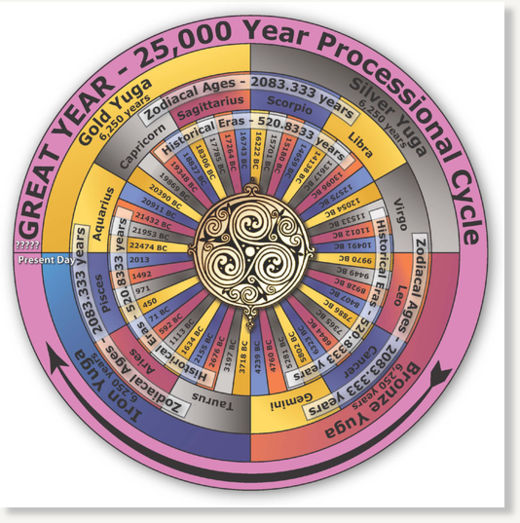
This calendar of the Great Year is divided into four Yuga, the equivalent of our four seasons in a solar year. These are named: Satya (gold) Treta (silver), Dvapara (bronze) and Kuri (iron). Within the four yugas are twelve rashis, the equivalent of twelve months in the human year. These are: Mesh (Aries), Varishabha (Taurus), Mithuna (Gemini), Karka (Cancer), Simha (Leo), Kanya (Virgo), Tula (Libra), Vrischika (Scorpio), Dhanu (Sagittarius), Makara (Capricorn), Kumbha (Aquarius) and Meena (Pisces). Right now, relatively speaking, we are transitioning from 2,000+ years in Pisces into the age of Aquarius. Aquarius brings us into the beginning of the 6,000 year long Gold yuga, believed to be a time of the purest age of truth and humanity under the rule of the gods. That may explain the exploratory ‘unexplainable’ craft that the USA government has now admitted have been entering our skies at will over the past 80 years. We can only hope there is truth in that.
We have just emerged from the Age of Pisces, end of the Iron Yuga on the Great Year Calendar. If we go further back in the cosmic calendar then the age before Pisces had been Aries, the Warrior, dating from approximately 2100 bc. Aries is a fire sign ruled by the planet Mars which has the characteristics of male aggression, strong passions, relentless determination, and a direct, uncomplicated approach in carrying out their ambition. From the history that is recorded, the Age of Aries did seem to climax over the latter five centuries with almost constant battles for supremacy within the main civilisations of Egypt, Greece, Persia, Rome and China. Many of the most notable historical characters of early first centuries bce were in fact generals or warrior kings: Alexander the Great, Mithridates of Persia , Qin Shi Huang founder of the Qin dynasty and Julius Caesar to name just a few.
As we moved through the Age of Aries, territorial wars were a constant feature of life. The Sumerians were conquered by the Babylonians around 2000 bce who were in turn were conquered by the Persians in 539 bce who went on to conquer Egypt and were constantly attacking the Greeks. It was Alexander the Great who restored order for Greece and by 300 bce had forced the Persians out of the Indus Valley, Syria, Judea and Egypt.
But as the Age of Aries came to its end, it was the Roman and Persian empires who were left facing off with each other for the finals of European/ North African and Middle Eastern dominance. By around 200 bce the armies from Rome had defeated the Greeks and Rome then ruled the former Greek empire, including Galilee and Judea. Julius Caesar was their most famous general conquering Western Europe as far as Gaul and Britain. But with the Romans having defeated the Greeks and now dedicating so much attention to Western Europe, Persia was also re-emerging as a greater military power in the middle east and with the technological development of horsemen archers and chariots, began claiming back territory lost to the Greeks and now controlled by Rome.
In 53bce the Persians lured 30,000 Roman legionnaires into open battle in the desert near a town called Carrhae, in modern Turkey, then surrounded them with their feared horseman-archers who rained shield piercing arrows on them and those who did not surrender were slaughtered, including General Marcus Crassus. In 41BC Marcus Antonius set off for Persia to avenge this slaughter. Along the route he called a meeting of allies and there he met and was famously distracted by Queen Cleopatra who invited him to winter with her in Alexandria. Now that is a classy chat-up line. The march to Persia was halted in Syria. Parthian Crown Prince Pacorus and a Roman deserter Quintus Labienus took advantage of his distraction and made a preemptive strike across the Euphrates River into Syria and conquering all before them secured much of the Syria, Palestine, Judaea regions. Ongoing battles between Rome and the Parthians tended to be long and inconclusive, But in 40bce Marcus Antonius’ forces moved quickly against Labienus who had legionaries, but only limited cavalry support; Labienus was killed and the Parthians retreated from Judea and Syria, allowing Antony and his forces back into this Mediterranean strip. Antony took revenge on some of the treacherous kings, including Antigonus of Judea, and then established the Herodian dynasty in Judaea. But Antonius’ greatest threat was in Rome against Octavian and finally when facing defeat in 30BC, Antonius committed suicide while with Cleopatra in Alexandria. Octavian became Augustus Caesar and this was the geopolitical situation at the end of the Age of Aries and the dawn of the Age of Pisces.
Further backdating along the Ages of the Great Year, from the period of approximately 4,000 – 2,000 bce was under the sign of Taurus, the Sensualist, the enjoyer of earthly pleasures. This period was known as our Bronze Age (beginning approximately 3,000 bce) which was the discovery of the metallurgical skills that contributed significantly to that civilisation, particularly introducing the invention of the wheel. And as it turns out, human civilisation as we understand it today emerged in the three regions of Crete around 3500 bce, Sumer in Mesopotamia around 3400 bce and Egypt in Northern Africa around 3100 bce; all within 400 years of each other. But in the Hindu Great Year this was the first age of the descent of man into the hedonism of the Kali (iron) Yuga.
It was the Minoans on Crete and other Aegean Islands who are recognised as creating the first great European trading city complete with its palaces, grand cultural, religious, administrative, and commercial centres; forums for public gathering and celebrations; workshops for artists; astronomical observatory towers, public baths and aqueducts. Around this same period in the Age of Taurus, similar civilised life also blossomed in Sumer and Egypt.
The Minoan civilisation was devastated by a massive volcanic eruption on the island of Santorini around 1500 bce which was possibly the original source of the legend of the sinking of Atlantis. Two hundred and fifty years after the collapse of the Minoans civilisation, Mycenaean civilisation evolved as the most advanced and distinctively Greek civilization on mainland Greece.
But going back older than 4,000 bce, we are entering the dvapara (bronze) Yuga of the Great Wheel, which extends back as far as 10,480 bce and was the first decline of man from the Treta (silver) Yuga and further beyond this time, the Golden Yuga. We have no stories of humans and human civilisation during these Silver and Gold Yuga, we only have mythical oral legends of Gods and their creation of humans.
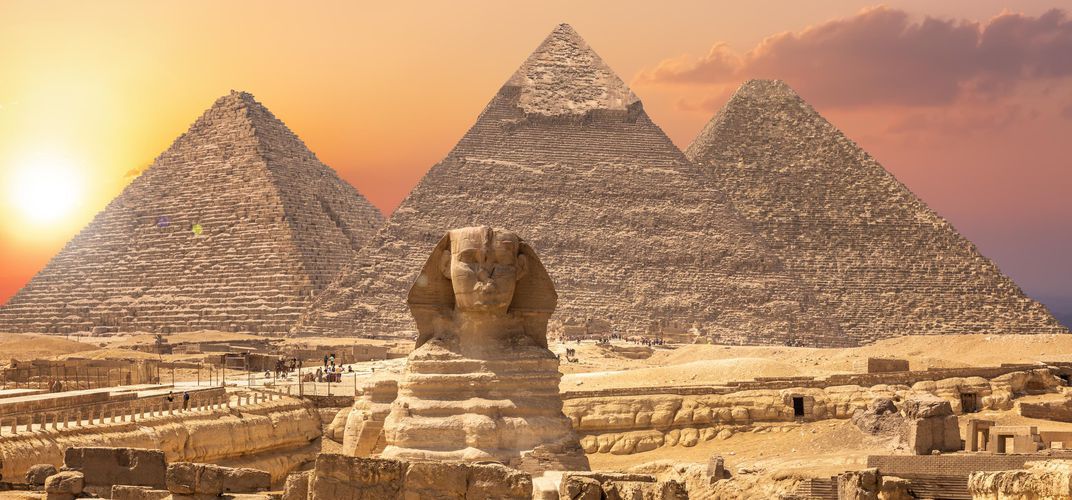
We have solid archaeological evidence, in construction terms, of the nature of civilisation during the 2000-year era of Pisces, but before this era the evidence becomes progressively more sparse and we then start relying more and more on pottery fragments, until we get to the great pyramids of Giza. These pyramids are staring at us, stone-faced, as monuments proving that long before us was an age of inhabitants with technology that we are only now starting to catch up with. But most interestingly there is no evidence of the expected progression of construction and engineering from the time the great pyramid until 221 BC with the great wall of China, and even that is hardly of the scale and technological level of the Giza pyramids. So what happened to civilisation in the timespan between the building of the pyramids and the building of China’s great wall or the Hoover Dam or International Space Station?
Mainstream archeology theory maintains the legend that Egyptian pharaohs engaged thousands of slaves in a technologically primitive time about 5,000 years ago, to build the great pyramids and Sphinx. The great pyramid of Giza is recorded as being the burial chamber Pharaoh Khufu who was recorded as reigning from 2589-2566 bce, a period of 63 years (although modern historians calculate the reign to have been between 23 and 34 years). There is carbon dating tracing the pyramids back 4-5,000 years aligning with Khufu’s reign, but carbon dating cannot date stone; it can only date organic matter. The removal of the limestone sheathing to build palaces 4-5,000 years ago would explain why the organic matter on the surface dates back to that period. And no doubt the pharaohs did build smaller replicas of the Giza pyramids for their own grand tombs, and these are genuinely 4-5,000 years old.
But let us focus on the originals, the three pyramids of Giza and their Lion headed Sphinx. Apart from the geometric precision and alignment of the pyramid, which defies rational explanation, there is the enormous physical achievement. Even presuming that Khufu did reign 63 years and began the construction of the pyramid at the very beginning of his reign; and even assuming that tens of thousands of Egyptians worked on the pyramid twelve hours a day, seven days a week for each of those 63 years, they would still have needed to put those stone blocks, averaging 2.5 tonnes, precisely into position on the pyramid at the rate of one every seven minutes. Add the complication that it is presumed the pyramid was mainly built during the farming off-season, then the speed at placing those stone blocks with such precision defies all credibility.
The great Pyramid at Giza weighs six million tons and used 2.3 million blocks, the largest of which are found above the King’s chamber and weigh from 25 to 80 tons each. There were an estimated 144,000 highly polished casing stones cut flat to an accuracy of 1/100th of an inch and nearly perfect right angles for all six sides measuring 8 feet thickness and weighting 15 tons each. Its footprint is 13 acres with each side measuring 750 feet and height is 481 feet. But apart from the sheer size and weight of the blocks supposedly carried large distances by slaves with no greater technology than ropes, rollers, pulleys and hand tools, the mathematical and astrological accuracy is mind blowing even today. The pyramid’s coordinates align it to cardinal True North with a precision of 3/60th of a single degree. True North cannot be located by sight or by a magnet.
The height and length of the great pyramid are not just random figures either. Take the pyramid height of 481 feet and multiply that by 43,200 and you get a precise measurement of the polar radius of the earth. Then take the length of the perimeter of the pyramid, 4 x 750 feet and multiply that by 43,200 and you get the equatorial circumference of the earth. And what does the figure 43,200 mean? I don’t know why a factor of 43,200 was the basis for the design of the pyramid although interestingly 43,200 is also the number of seconds in a 12-hour day or the number of minutes in a month. The earth’s ‘wobble’ adjusts our precession through the astrological circumference by one degree every 72 years and 72 is also an exact factor of 43,200 (1/600th). So the number does have some natural basis aligning earth with the cosmos.
The Giza pyramid sits directly over an invisible electro-magnetic ley line and is aligned within 0.05 of a degree accuracy due true north/south. The Sphinx, as part of the pyramid complex, is an astrological alignment facing due east for the Spring equinox, which is also no accident. It is in lion body form, which was not just a whim of the architect and the sun at Spring equinox was last in the constellation of Leo in the 9,000 bc era. 9,000 bce was also the timing of the emerging of the earth from the 1,000-year nuclear winter of the Comet-created Younger Dryas. If, at the sunrise on the Spring equinox, you turned 90 degrees to face due south you would have seen the three stars of Orion’s belt appear in the exact same alignment as the three pyramids of Giza. The mathematical and cosmic precision of the dimensions is not coincidental; the Sphinx is the oldest calendar marker in our human history and was placed there to mark a significant time in our history. It was built to enable us to interpret, more than ten thousand years later, the timing of the comet strike that destroyed what civilisation had already existed on the planet and that a new era for humanity was about to begin.
This was the Age of Leo when Earth was emerging from the Ice Age and the planet was warming. individuality started appearing. Humans started, or re-started, to organise the primitive social structures and brought on the horizon the first human priests/rulers/shamans of human origin (it is believed that prior to this time humanity was led by more advanced mentors/creators). The symbol of the Sun, the sign of Leo, is deep in all ancient religious records.
The Giza pyramids themselves may have been much older than the Sphinx. They were all built in hard granite and, as we all know, granite makes the highest quality batteries. Then they were sheathed in low conductive limestone slabs laid with laser sharp engineering precision to contain the energy within.
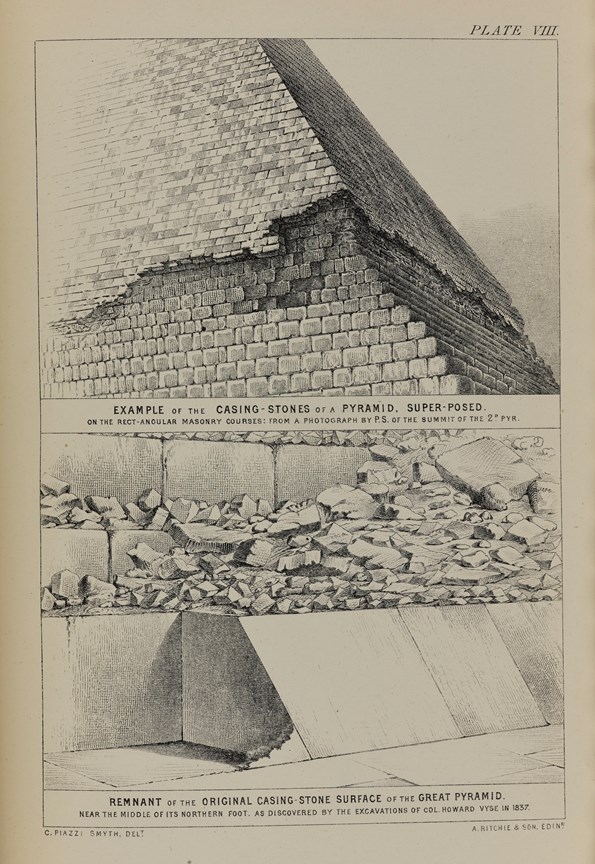
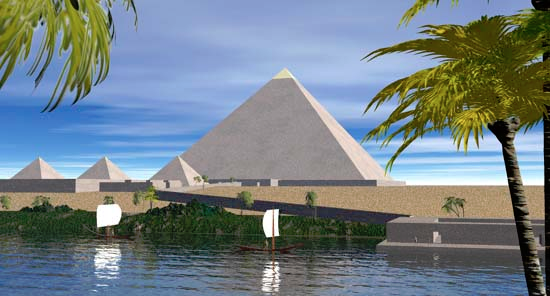
The largest of the great pyramids was gleaming white in its original state before, in later millennia, the polished limestone coating slabs were plundered to build the palaces in the region. The other two smaller pyramids were red and black granite respectively. At the time of construction, a branch of the Nile ran right to the pyramids providing a water table beneath the pyramids; they were built strategically on a magnetic lay line and they had the direct energy source of the sun with legend telling us the capstones were sheathed in gold.
In effect, the great pyramid of Giza had all the elements of a huge power generator that could supply the nearby city. But most importantly this would have been an implosive power source compared to the explosive nature of fossil-fueled power. Thousands of years later the free and renewable power creating technology of these pyramids consumed the genius mind of Nicolas Tesla.
But equally intriguingly, beneath these pyramids of Giza is a huge network of caves and passageways. British consul general Henry Salt records in his memoirs that he investigated an underground system of catacombs at Giza in 1817 in the company of Italian explorer Giovanni Caviglia. The document records that the two explored the caves for a distance of several hundred yards, coming upon four large chambers from which stretched further underground passageways. The full layout of these underground chambers remain a mystery today although in 2009 author Andrew Collins published a book demonstrating that he and Egyptologist Nigel Skinner-Simpson had followed Salt’s exploration and had themselves discovered the entrance to this huge underground complex.
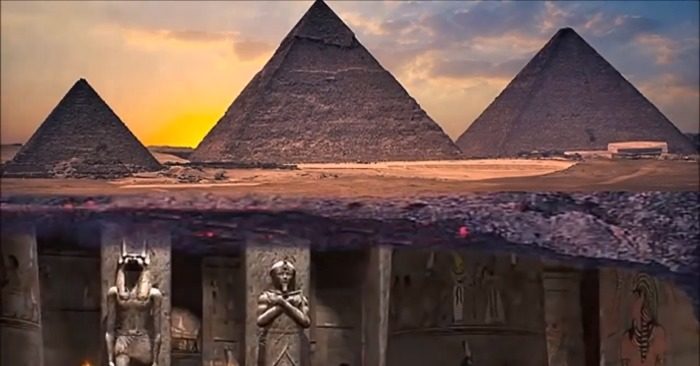
The Ancient Guy/Screenshot credit: TheBL/Youtube
Sceptics scoff at the idea that an advanced civilisation inhabited Earth and influenced us and our planet with their advanced intelligence and technology; but either that happened or our ancestors of at least 200 generations ago were capable of all this extraordinary astronomical, geographic, and engineering precision without the aid of computers, satellites, cranes or any machinery. We must dispense with the notion, once and for all, that humans built these Pyramids with their only tools being axes, ropes and timber logs. That is simply nonsense. The Pyramids were built using satellite-sourced co-ordinates, computer-assisted planning, laser-precision stone cutting technology, and anti-gravity lifting technology.
But what to the modern era? Anno Domini, AD means since the birth of Jesus the Christ. The AD/BC calendar only came into being in 525 AD. It was calculated by a monk, Dionysius Exiguus, so that everyone in Christendom could align their calendars and celebrate Easter on the same day. At the time there was a schism between the Orthodox Christians of the East and the Roman Christians of the West and Pope John 1 felt the need to synchronise Easter globally. The Pope adopted Dionysius’ calendar for all nations under his control. Historians have now concurred that Dionysius was out by a few years in his calculation. The inability to reliably use BC/AD to align with historical events is why modern historians now refer to CE (Common Era) and BCE. In a separate essay, ‘A mid-winter night’s tale’ I concluded that the Star of Bethlehem which announced the birth of Jesus Christ was in fact the very bright conjunction of two planets, Jupiter and Saturn (father and son in Greek mythology) occurred in 4 bc, which also aligns with Herod the Great still being alive at the time of Jesus’ birth.
Whatever precise year it began, the birth in Galilee of Yeshua (Jesus) has undoubtedly been the defining event to introduce the Age of Pisces. Yeshua was born to Myriam, by way of a visitation by non-earthly beings and consequential artificial conception, and was the adopted son of Yasaf. The constellation name ‘Pisces’ means the fish. The symbol of Christianity is also a fish and had been adopted as such by the Greeks about two hundred years prior to Dionysius. Jesus first recruited fishermen as his disciples and told them they would become ‘fishers of men’. The miracle of the multiplication of the fishes and loaves features as a significant event in the Bible and the ‘153 fish miracle’ was the demonstration of the miraculous powers of the resurrected Jesus.
Pisces is ruled by the planet Neptune which is known as the water planet; the mission of Jesus was first announced with Jesus’ baptism in the waters of the Jordan River and to this day adoption into the Christian faith is done by baptism with water. The health of those born under the star sign of Pisces is characterised by issues with the feet (fish were never meant to walk). It is a practice of the leaders of Christianity, beginning with Jesus himself and continuing to the Popes of today, to ceremonially wash the feet of the common people.
Pisces is also characterised by the creative arts. Indeed, the last few hundred years of the age presented the greatest surge of artistic creativity in humanity’s known history. From the artistic renaissance period of Da Vinci and Michelangelo through the phases of impressionism of Monet and Van Gogh to the cubism of Braque and Picasso. The Renaissance also saw the invention of the printing press and thus the emergence of great writers of the era such as Shakespeare and Chaucer.
That is not to say the age of Pisces was without war and conflict; far, far from it. But for most of this Age of Pisces war took on a totally different guise. War before the common era, before Pisces, was characterised by the blunt, brutal and transparent ambition of military leaders; Pisces by contrast was a wolf in a sheep’s clothing or in Piscean terminology, a shark in a dolphin suit. It started with Emperor Constantine of Rome absorbing the established Christian Church under his control and from then using that acquisition as Rome’s divinely authorised cover for it’s political, military and economic control of Europe throughout the middle ages of Pisces. This included the Crusades against Islam in Spain, Africa and the Middle East, the Inquisitions against Protestants and the sending of Christian missionaries to conquer the souls of South Americans, Japanese, Chinese, Indians and Filipinos. Conquest in the Age of Pisces was done in the name of a patriarchal religion and its higher authority. It conquered by the terror of damnation to eternal hell and it was, commercially, very successful. The Church of Rome which dates back to Emperor Constantine of Rome became the wealthiest institution on the planet.
In the late 19th century Darwin’s theory of survival of the fittest spawned a social movement which was coined by Sir Francis Galton, an English scholar, as ‘eugenics’. Early in the 20th century the concept was picked up by American John Kellogg who, with his brother Will developed the process of flaked corn which Will subsequently turned into the Kelloggs company. Walt Disney is reputed to also have had such a eugenics philosophy and, of interest, in 2001 Disney/Kelloggs established a joint business venture with a Disney themed cereal. Eugenics became a popular social movement in the United States that peaked in the 1920s and 1930s. Books and films promoted eugenics, while local fairs and exhibitions held “fitter family” and “better baby” competitions around the country. The eugenics movement in the United States proposed the elimination of undesirable traits from the population. Proponents of this movement reasoned the best way to do this was by preventing certain individuals from having children. During the first part of the twentieth century, thirty-two States passed laws that resulted in the forced sterilisation of more than 64,000 Americans including immigrants, people of colour, unmarried mothers and the mentally ill. But this movement of applying animal husbandry logic to humans soon morphed into barbaric, inhumane, racial genocide with the emergence of Germany’s Nazi Party.
This eugenics movement was soundly defeated in WW2 by the humanitarians. Although ironically it was the ruthless and horrific use of indiscriminatingly dropped bombs from the sky on hundreds of thousands of non-combatant citizens of all ages that brought an end to the war on eugenics and ‘victory’ for humanitarianism. And that included the development and use of the atomic bomb which also ironically created the current humanitarian peace model of ‘mutually assured destruction’, with the appropriate acronym of ‘mad’. Today the outcome of our liberal humanitarianism is a population that is escalating exponentially out of control.
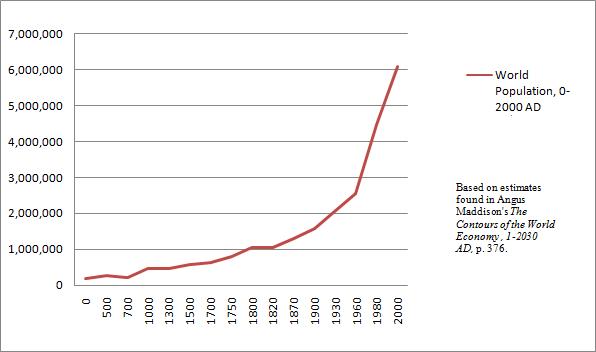
The phenomenon of exponential growth shows in the human population reaching 1 billion around 1800 a.d. rising to 2 billion less than 100 years ago then escalating exponentially to 4 billion only 40 years ago and about to reach 8 billion any day now. The progression takes us to 10 billion in a matter of a couple of decades, if not controlled. The damage that such exponential growth does to our planetary body is the same as a virus does to our own body or an infected body does to an entire community. It is not so much the actual resources of coal and oil that is causing the present environmental impact of the planet, it is the sheer volume of the use to keep this huge and growing population alive that is causing the damage to our environment.
The last generation of Pisces began to foresee and prepare for the Age of Aquarius. This preparation for Aquarius first emerged in the 1960’s in San Francisco, rose to the big stage in New York’s production of Hair the Musical in 1967, was worshipped in Bethel N.Y.’s Woodstock in 1969 and welcomed to the world by “Blue Mink” proclaiming that ‘what we need is a great big melting pot.’ This counterculture was singing out for a world of coffee-coloured people. We wanted to travel; to experience other cultures; create fair trade to share the wealth of the first world with the third world. We were rebelling against greed and selfishness, against hate and prejudice. It all seemed so idealistic, we were so ‘woke’ to injustice, but it ended up with a McDonalds photo-bombing the Giza Pyramid. Where did it all go so wrong?
This movement began promisingly bringing with it both jet travel and the internet to help make the global village vision a reality. But the word of warning to humankind is the power of the mathematical phenomenon called exponential growth. Start with you as one person infecting just two people who each infect two people, who each infect two more people and you now have eight people infected; three further steps take it to 64. Three further steps take it to over 500; and just three more steps and you are over 4,000. And that is with each person only infecting two others. Our civilisation moved from being a boutique world 50 years ago to being a hyper-store world today. Air travel has accelerated exponentially by 80% from 2004 to 2012. With the power of technology, flight data companies like FlightAware can tell us that on any average day last year there were around 10,000 aircraft in the sky at any one time. Jets consume 150,000 litres of jet fuel on a 10-hour flight. We became a world focused on globalisation and perpetual population expansion, economic expansion and mass consumerism.
In 2020, the last year of the Age of Pisces, a highly dangerous virus spread from Wuhan, central China across the entire planet. A pandemic was declared and we were all part of a global lockdown. Life as we knew it changed dramatically. Confined to our own home-bubble except for highly regulated essential movement. This virus appeared to primarily attack the oldest of our population, the last of the Pisceans.
The virus has been analysed and found to have come from bats. Initial blame for the virus is that bats may have infected some other mammal that somehow found its way into a seafood marketplace in Wuhan, Central China. Further analysis of the situation is emerging to suggest that the virus released in the Wuhan seafood market may well have been a human-to-human transmission and so focus then went onto the nearby biosecurity laboratory that studies bat-sourced viruses. It may very well have been human curiosity opening Pandora’s box of infectious diseases that has caused this pandemic.
It was jet travel that spread the Covid-19 virus from Wuhan to almost every geographic cell on the planet; follow the pattern of a computer simulated 24-hour pattern of global flight and you will essentially be watching the transmission of this virus. But it was the internet that spread the panic. If you are looking for any cosmic link to Wuhan being fated to be the spark to launch this pandemic, there are two. In the 1858 Treaty of Tianjin, ending the second Opium war that Britain waged on China, Britain demanded access to Wuhan, right in the heart of China, for trading purposes. Wuhan is strategically located at the confluence of the Han and Yangtze rivers and provided access to all the products and industry in central China. The weakened Qing dynasty had no choice but to agree and Wuhan became known as the Chicago of China as a vital trading post where several Western trading countries had land concessions and consulates. What the West finally imported from Wuhan 160 years later is a lesson for all bullies to be careful what you demand.
The second connection to Wuhan is that in 1911 the republican revolution of China was launched there. This liberal revolution led to the overthrow of the Qing dynasty, the last Imperial dynasty of China that had begun in 1644. That capitalist-based system was subsequently seen by Mao Zedong and his followers as a political virus and ridding the country of it resulted in a death toll in the tens of millions, many from starvation, before it was quarantined to the island of Taiwan. It seems Wuhan has history.
But from 2021, as we start to adjust to life with an ‘out of control’ virus, earth has officially moved into the age of Aquarius. Aquarius is ruled by the planet Uranus; the planet that governs innovation, technology, and surprising events. Indeed, I must concede that our new religion appears to be technology. Today our people increasingly consult ChatGPT, rather than the priest of a patriarchal religious corporation, to seek the answers to life’s mysteries. Increasingly we are using machines to do much more of the work from factories to hospitals while humans travel from one conference to the next to have intellectual conversations about the state of the world and humanity.
I am a thoroughbred Pisces; born in the age of Pisces, during the March equinox under the star sign of Pisces, on the night of the new moon and with the ruling planet of Neptune in retrograde. In 2022 I feel like a fish out of water, but I have no doubt that the Universe knows what it is doing. Aquarius, this is your Age. May the Gods be with us.


You must be logged in to post a comment.