Posts Tagged history
New Year, time to think
Posted by tonypcollins in Uncategorized on January 14, 2026
It’s January again, which means we have quietly stepped back onto the familiar twelve-month wheel — the long months and short ones, the drifting dates, the lopsided February — without ever really stopping to ask why time is divided this way at all. We reset our diaries and calendars as if this structure were natural and inevitable, when in fact it is neither. We inherit it without question, even though other, simpler ways of measuring the year have always existed. We get discombobulated with Christmas day, New Years day and other anniversaries all moving to different days of the week each year. Life would be so much simpler if they always fell on the same day of the week. So what if there is a way of dividing the year that is so simple, so symmetrical, and so human‑friendly that it almost feels obvious — and that the only reason we do not use it is because of an eleven‑minute error made by Julius Caesar two thousand years ago?
The calendar we all live by — the Gregorian calendar — exists almost entirely to fix a mistake in the Roman one. The old Julian calendar assumed the year was about eleven minutes longer than it really is. Over centuries, that tiny error caused the spring equinox to drift earlier and earlier. But the Church had used a fixed date, 21 March as the Spring equinox and by the 1500s it was ten days out. The calendar we live inside today — with its uneven months and centuries-old quirks — was laid down in 1582 by Pope Gregory XIII as a reform of Julius Caesar’s older system, not to make daily life simpler but to keep the date of Easter aligned with the seasons. Because the most important festival in Christianity, Easter, is not fixed to a date at all. It is defined as the first Sunday after the first full moon after the spring equinox. When the equinox drifted, Easter drifted with it. That meant that the celebration was moving further back from Spring with its rebirth/ resurrection symbolism and backwards with Lent preparation then in the depths of Winter. Theology had slipped out of step with the weather and Pope Gregory decided that had to change.
So the Church rewrote the calendar. Ten days were removed. Leap‑year rules were changed. The months were left as they were. All of it was done not for the convenience of daily life, but to keep the resurrection aligned with a solar‑lunar choreography inherited from much older traditions. In a quiet way, that means Christianity’s most sacred moment is still tied to ancient sky‑watching. The story of the Three Magi — Persian astronomers who followed a star to the birth of Jesus — reflects the world Christianity emerged from: one in which celestial rhythms mattered deeply.
And that is the quiet irony: the modern world keeps time the way it does because Christianity had to keep Easter aligned with the Moon.
Thirteen months of twenty‑eight days give us 364 days: exactly fifty‑two weeks. Every month has four neat weeks. Every date always falls on the same weekday. No drifting holidays. No short February. No long, lopsided months. It is the closest thing to a perfectly designed calendar that human arithmetic allows. The 365th day would simply become a ‘year-day’. Everything would simply stop for a one day reset which would truly be a New Years Eve. This is not a new idea; in1849 Auguste Comte proposed it. In 1902 Moses Cotsworth formalised it as the International Fixed Calendar. From 1928 to 1989 Kodak ran its entire global business on a 13-month calendar. It worked so well they refused to change until computer systems forced them.
Modern psychology helps explain why this matters. Human beings thrive on regular rhythms. Predictable weeks and routines support sleep, mood, and a sense of control. A calendar in which time repeats cleanly would not just be easier to plan — it would be easier to live inside.
Calendars are not just cultural habits. They are embedded in banking systems, tax law, software, contracts, pensions, and international agreements. To change the calendar today would mean rewriting the legal and digital spine of civilisation. That does not happen because something is elegant or humane. It happens only when something overwhelmingly powerful insists.
There is a strange physical symbol of all this in the most complicated watch ever made: the Vacheron Constantin Reference 57260, sometimes called the Tivoli.
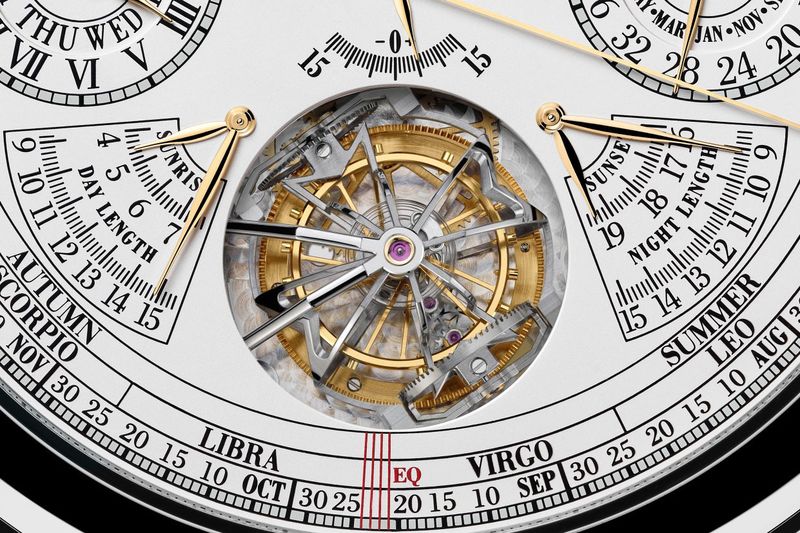

Built by three watchmakers over eight years for a single client, It is undeniably a pretty cool watch. There’s an astronomical calendar, which includes a display of the phases and age of the moon, a hand that tracks the movement through the Zodiac along with the equinoxes and solstices and a rotating sky chart. There are three full calendar systems in this watch. The first is a Gregorian perpetual calendar that includes displays for the date with a retrograde hand, day of the week, month and year in the leap year cycle. There are also indicators for the number of the day of the week and number of the week in the year in accordance with the ISO 8601 standard calendar. There is also a Hebrew perpetual calendar which shows the Hebrew name of the day, Hebrew name of the month, Hebrew date, Hebrew secular calendar, Hebrew year, whether the year has 12 or 13 months, where in the 19-year lunar cycle this year is, and the date of Jewish holy day Yom Kippur, which moves around the calendar. It has a double retrograde split-seconds chronograph and…. it tells the time in both sidereal and solar hours and minutes. Sidereal time tracks the earth in relation to the stars instead of in relation to the sun and differs from solar time by plus or minus a few minutes. Sometimes a few minutes make all the difference. You can also see what time the sun will rise and what time it will set in the watch owner’s home city as well as how long the day and night will each be on that day. The hours and minutes are shown with regulator-style hands, meaning the hours and minutes are on separate axes. The small gold hands show a second earthly time zone.
It is breathtaking, but it is also quietly absurd. Time itself is simple: the Earth turns, the Moon circles, the seasons pass. The watch is complex because human history is. It exists to reconcile Roman months, Christian Easter, Lunar cycles, Hebrew Calendar and centuries of patched-together rules. In a way, it is the mechanical opposite of a thirteen-month calendar: a monument to how elaborate our systems become when we refuse to let time be simple.
We often think calendars are neutral tools, but they shape how rushed or settled we feel, how we plan, how we remember, and how we rest. A few things become clear once you start looking at calendars closely:
- A thirteen-month year creates identical months and predictable weeks.
- Dates and holidays would always fall on the same weekday each year.
- Weeks and months would finally align cleanly, without spilling across one another. the 1st of the month is always the same day of the week, as is the 28th of the month.
- Billing, pay cycles, school terms, and planning would become simpler and fairer.
- The extra “Year Day” would introduce a natural pause rather than another deadline.
- Our current system persists not because it is better, but because it is deeply embedded in law, finance, culture, and software.
As this New Year gets underway, is it time to question why we still live inside a calendar designed to solve a sixteenth-century theological problem — when a gentler, more human rhythm has always been waiting just beyond it.
And perhaps in an age where software and artificial intelligence can quietly reconcile complexity for us, it is at least worth asking whether the way we organise time still needs to be as tangled as the history that created it.
And it makes you wonder: if we gave time a little more symmetry, with a ‘one day pause’ in between would we live our life just a little differently?
 it's thursday….
You must be logged in to post a comment.